The Essential Pages To Make Your Real Estate Website Successful

In today’s competitive real estate landscape, your website is more than just a digital business card that showcases listings to those who decide to click. It’s also your most valuable 24/7 lead generation engine. There are a few obvious conventions that a top-tier real estate website needs to follow, including balancing aesthetics with functionality—guiding potential clients seamlessly from the first click to the handing over of the keys.
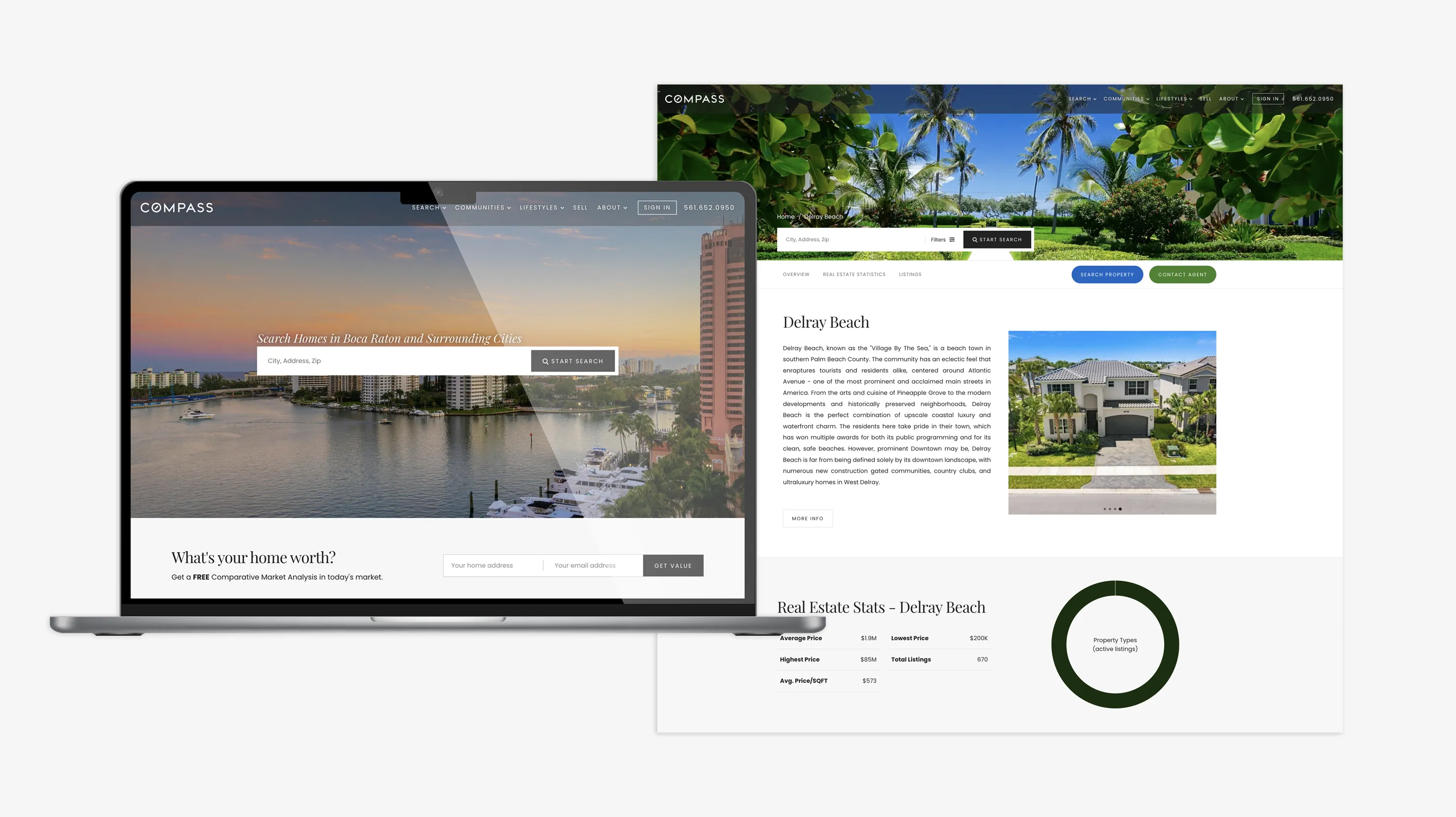
Caesar Parisi's homepage & community page on bocaexpert.com
But which pages are truly essential to capturing attention and converting leads? And how do you know what to include and what not? While personal preference, ideal clients, location, and other factors should be taken into account, there are some general guidelines you can follow.
Whether you are a solo agent or leading a team, building a high-performing site starts with a deliberate architecture designed to establish trust, demonstrate authority, and solve problems for your clients. Let’s explore the things a site must have!
Table of Contents
The Homepage: Stand Out
Sometimes referred to as your “digital storefront”, your homepage should effectively illustrate your brand and important information about you—such as your area of expertise/any speciality, listings, and ways to get in touch with you.
Essentially, your homepage should state your mission: who you are, what you do, and what sort of client you would like to work with. You’ll also want to answer the question of why a client should want to work with you.
Structurally, this means a large image or video, followed by elements that convey your expertise in your field, without overwhelming your potential clients with too much text or trying to fit everything onto one page. Incorporating interactive elements, such as market analysis tools or real-time market metrics, offer immediate value to the visitor rather than just a sales pitch.
Smith & Associates Real Estate using a video visual for their homepage hero
Your top navigation should link to your site’s most important pages. For real estate agents, this will mean your (top) communities,
Community Pages: Establishing Local Authority
Community pages are your site’s foundation—or sometimes thought of as the “secret sauce” for SEO. These pages have a significant portion of your site’s content, directly related to your business and the area that you sell in.
A good community page has the following:
- Beautiful, high-quality (and ideally original) images
- A descriptive headline and page title
- A brief overview of the area
- Active listings
- More content, with links, that honours the conventions of EEAT
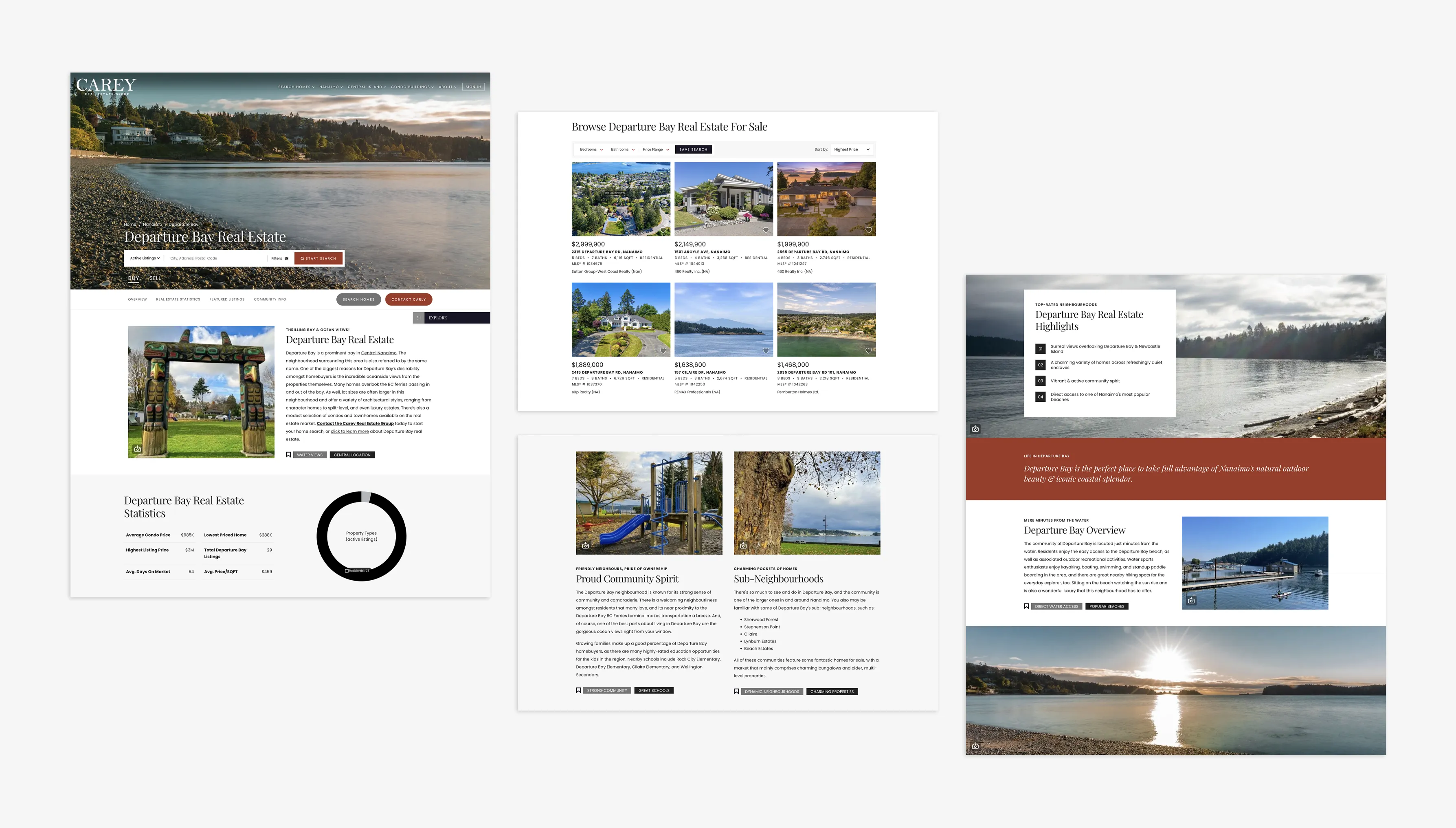
Carly Carey Real Estate Team's Departure Bay community page
From an SEO standpoint, community pages pull in traffic, but more significantly, these pages are beneficial in helping you position yourself as an authority on this area. These pages serve to tell site visitors the things they need to know, making it easy for buyers to visualize what living there might be like.
You’ll also want to link internally to other community pages, when mentioned, blog posts, and subpages—the latter of which is incredibly important and part of the content pillar method. This site strategy involves creating related subpages that support the main page. For example, you might have a main page about Vancouver real estate, with subpages on condos in Vancouver, single-family homes in Vancouver, and townhomes in Vancouver.
A well-done community page sees a high average session duration—but be sure to include calls-to-action to capture your leads.
The Blog & Resource Pages: Thought Leadership
While community pages will have information directly related to the area it is about, the blogs section of your site allows you more freedom and flexibility in regards to topics. It is highly recommended to use your blog to reach its full, organic traffic-capturing potential.
Your blog should also follow EEAT—Experience, Authority, Expertise, Trust. You have insider knowledge about the area and the real estate market, so use that to your advantage! People are genuinely curious about what it’s like to live there, and when it comes to blog writing, you can showcase this through topics like local business features, market updates, promoting your own listings, home improvement and buying/selling tips, and so much more.
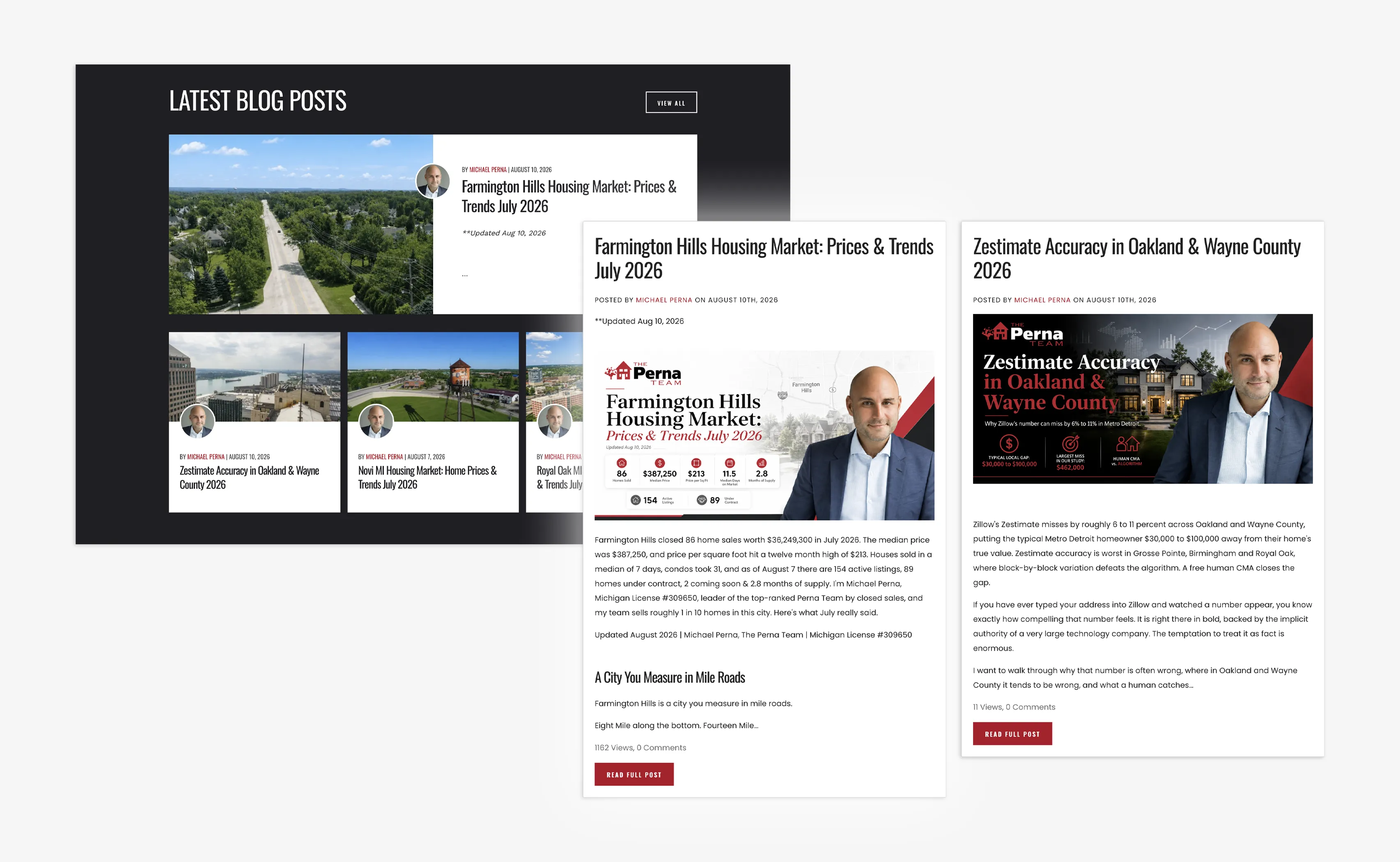
Mike Perna from The Perna Team practicing EEAT through blog posts
Through this, you build your authority, and use fresh, relevant content to keep your audience engaged. This type of content is great for generating organic traffic, and if used correctly, can get traffic from potential clients that you are actually chasing. In short, you’ll need:
- Beautiful, high-quality (and ideally original) images
- A title that grabs attention (but still stays relevant)
- Great content about something you’re familiar with
- Links (internal and external)
Linking your blog articles to other site areas (like community pages, other blogs, and resource pages) also help keep users moving through your site.
Resource pages work in a similar way to blogs. Generally, however, these are more specialized and focus on aspects of the home buying and selling process, through the lens of the area you work in.
For example, you might have resource pages on mortgages, preparing your home for selling, or what the experience is like with a realtor (and how that would benefit someone!). In contrast, a blog post might talk about the history of a landmark building, family-friendly or up-and-coming neighborhoods, new developments, standout restaurants, or just listed properties.
It’s crucial to remember that being helpful—not just promotional—builds the authority that you want.
Link Building & SEO: The Engine Under the Hood
Now that we have the basic pages, we can further discuss the linking process—which is something that is often overlooked but is incredibly important for realtors looking to build out their website.
It’s not enough to just have a great homepage, community pages, and blogs/resource pages. We also need to create an intricate network where all of these pages are linked (and therefore supported) by each other. Not only does this keep visitors on your site for longer, but search engines—and now AI models—recognize the structure of your site and favour it because of it.
There’s still a lot of uncertainty when it comes to AI tools and how best to “show up” in the results, but using Real Estate Webmasters’ features can help make content creation and visibility easier.
NORÉ, for example, uses AI to instantly create different types of content based off of your original video transcripts, while also creating new video pages and adding schema markups to them. llms.txt is an experimental feature that provides Large Language Models with a “roadmap” of your site so that they can better understand who you are, what you do, and what’s most important.
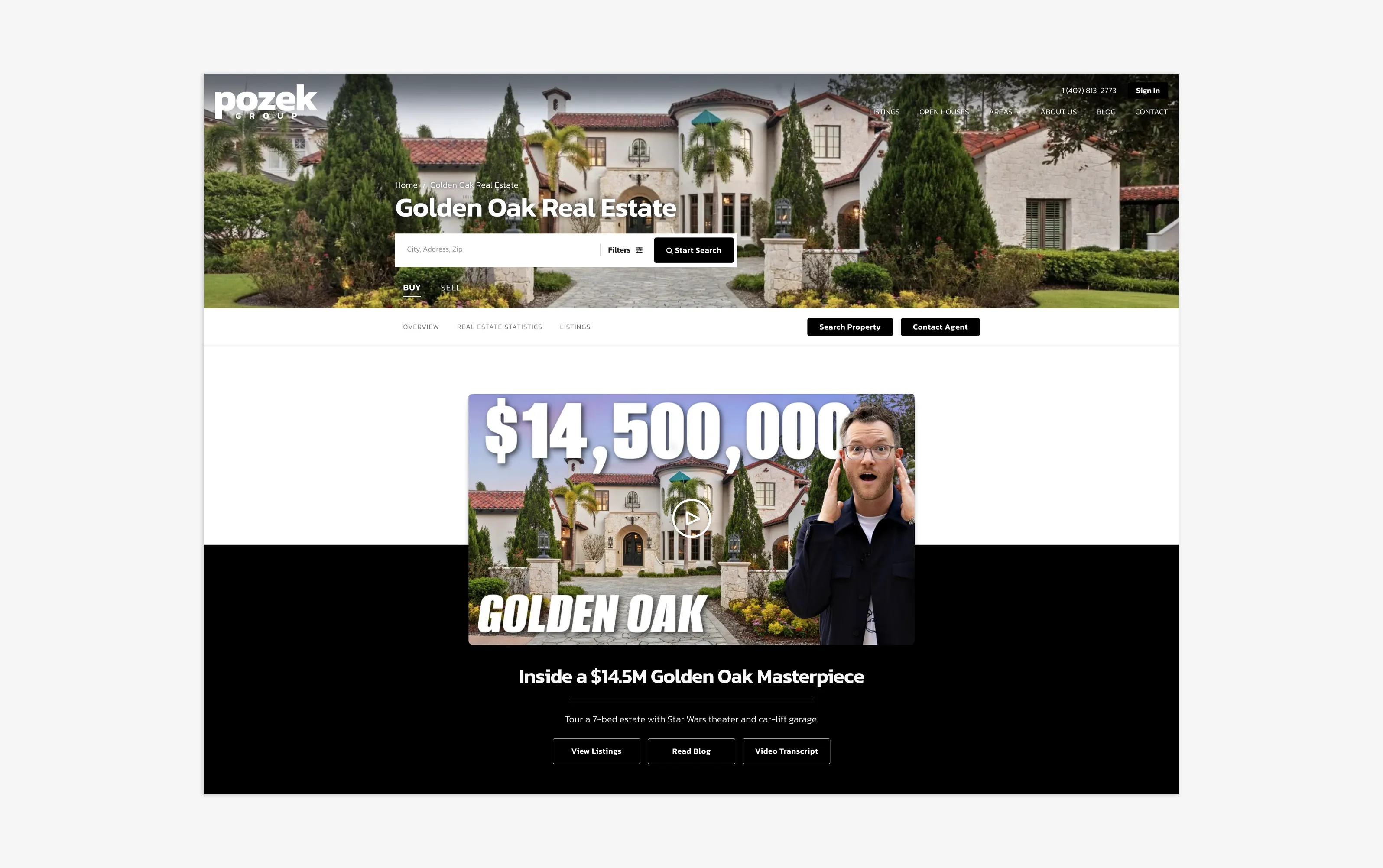
Ken Pozek from The Pozek Group showcasing original videos for SEO via NORÉ
Together, these strategies work together to build your site’s reputation, and working with REW gives you a technical edge that is highly-desirable—because it works.
Closing Summary
While these pages—a well-thought-out homepage, community pages, and blogs/resources—are integral to spotlight who you are, you also have to know if your existing pages are working for you or against you.
Not sure about your performance? Get in touch with us to discuss our main focuses: websites, leads, and CRM. At Real Estate Webmasters, we help you build a digital environment where your brand shines and your leads convert.
The Essential Pages To Make Your Real Estate Website Successful FAQs
How often should I post on my blog?
There are no set rules when it comes to frequency of posts. However, keep in mind a few things: don't value quantity over quality, but also don't go so long between posts that you struggle to get any traction. Keep to a doable schedule; for many, that can be once a week.
Does Real Estate Webmasters offer content writing/blogging services?
REW specializes in PPC and SEO services. Our SEO Specialists can use project time for content development, but this is just one aspect of the work that they can complete for your website.
Must I have a perfect homepage, community pages, and blog in order to rank organically?
Rather than perfect, strive to have pages that are functional, with good content, links, and easily visible ways to get in touch with you. Content (and building authority) is something that takes a lot of time, so results aren't typically instant!
What tools does REW offer that makes it easier to succeed?
Our powerful CRM and tools such as NORÉ help realtors and brokerages manage leads and develop content.