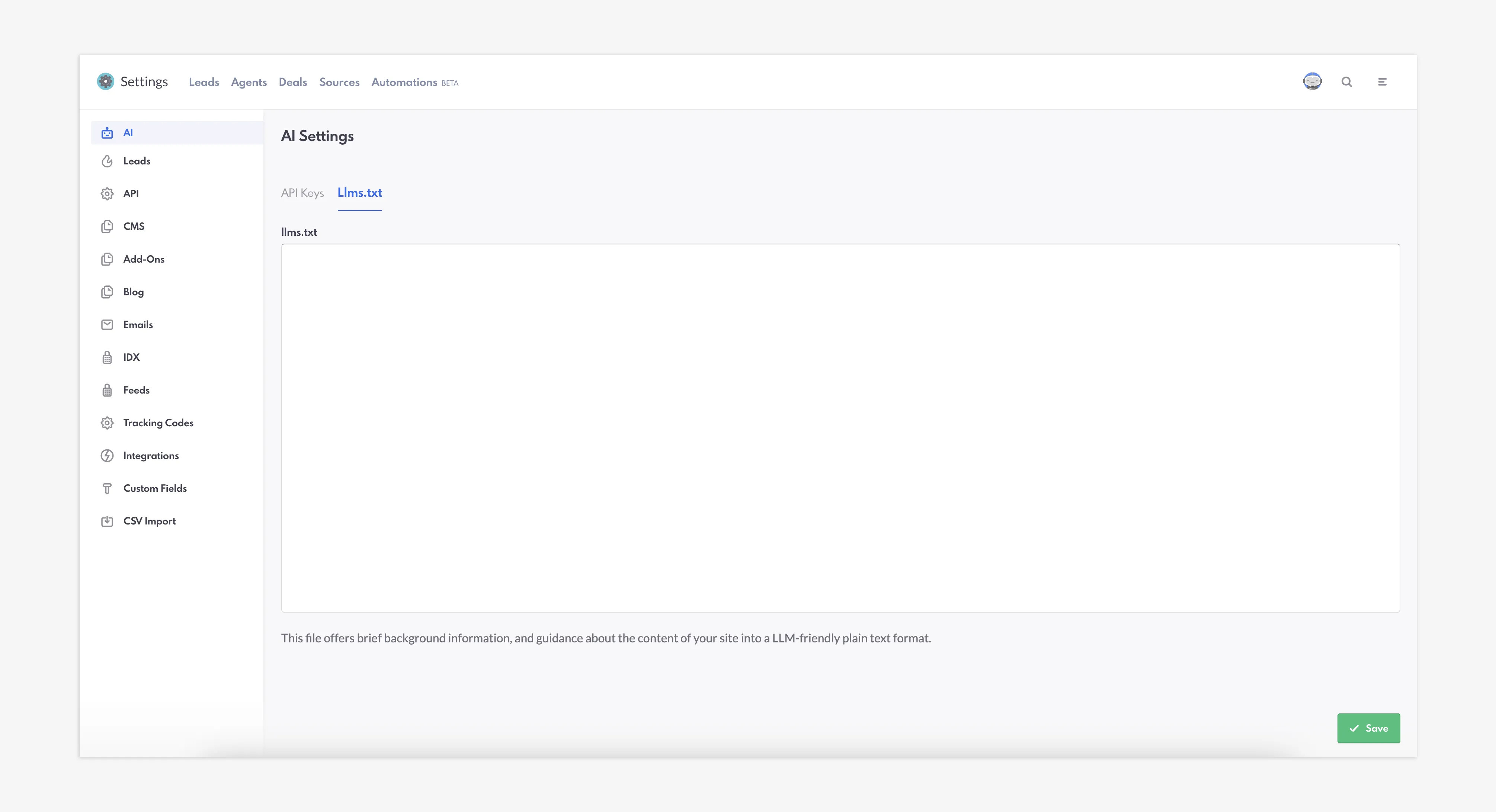
Continuing with our summer release preview, we’re excited to announce the upcoming llms.txt file feature!
As AI search results become increasingly vital for businesses, this new tool aims to help you stay ahead of the curve. The llms.txt file acts as a “roadmap” for AI, providing essential details about your business, your target clientele, the market, and your key focus areas. By offering this clear overview, you may help AI tools develop a deeper, more accurate understanding of your website.
This is a more experimental approach, but might aid in improving your site’s visibility across various AI platforms—effectively attracting high-quality leads and driving business growth.
You will be able to access llms.txt within the new AI tab in the Settings section. Discover more about llms.txt and its potential advantages in our latest blog post here.
That’s a great suggestion. Since our listing pages are dynamically generated from MLS data, there are a few considerations around implementation and compliance, but it’s definitely an interesting area for us to investigate further.
Are there any specific schema types or use cases you’ve found particularly valuable?
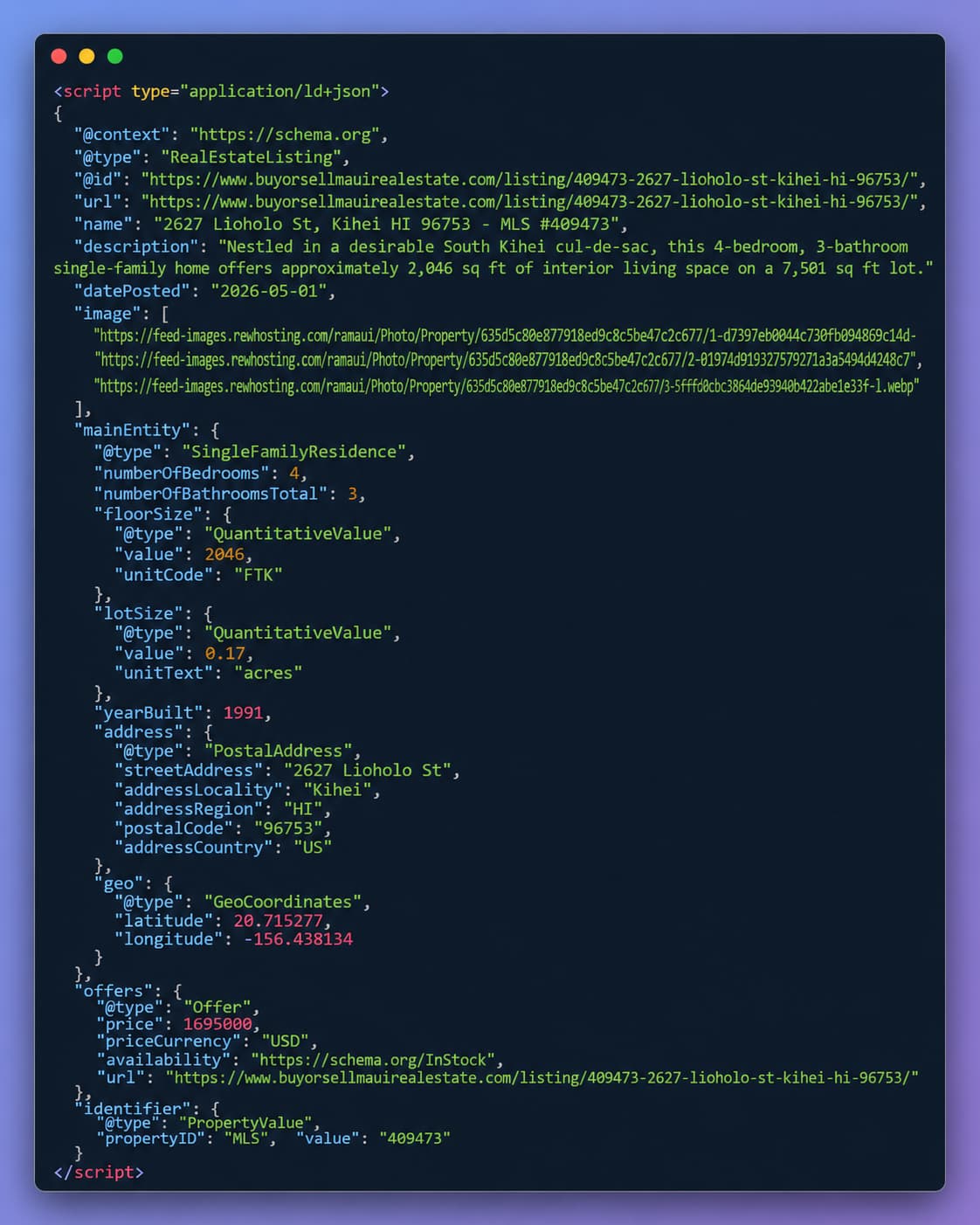
Thanks Fernando. Basically, we’d be just taking the listing data that’s already in the page and restructuring it as schema so AI tools and LLMs can read it cleanly. JSON-LD doesn’t expose anything new, and broker attribution is supported natively via the broker property.
For property detail pages, the priority is RealEstateListing with a nested SingleFamilyResidence, Condominium, or Apartment (mapped from ListingSubType) and an Offer node for price and availability.
What’s missing (schema-wise)
No <script type="application/ld+json"> block anywhere
No Microdata (itemscope, itemtype, itemprop)
No RDFa (vocab=, typeof=, property=)
No RealEstateListing, SingleFamilyResidence, Residence, Product, or Offer markup
No BreadcrumbList
No Event schema on the open houses (which is its own missed opportunity for rich results)
For context, here’s a current listing detail page:
And here’s roughly what the JSON-LD would look like, populated with that listing’s data. (image attached)
Thanks @GregBeddor, appreciate you taking the time to explain it and put together the examples. Seems like a reasonable suggestion that’s worth exploring further.
We always appreciate this kind of feedback and the time everyone takes to share ideas and start discussions like this.